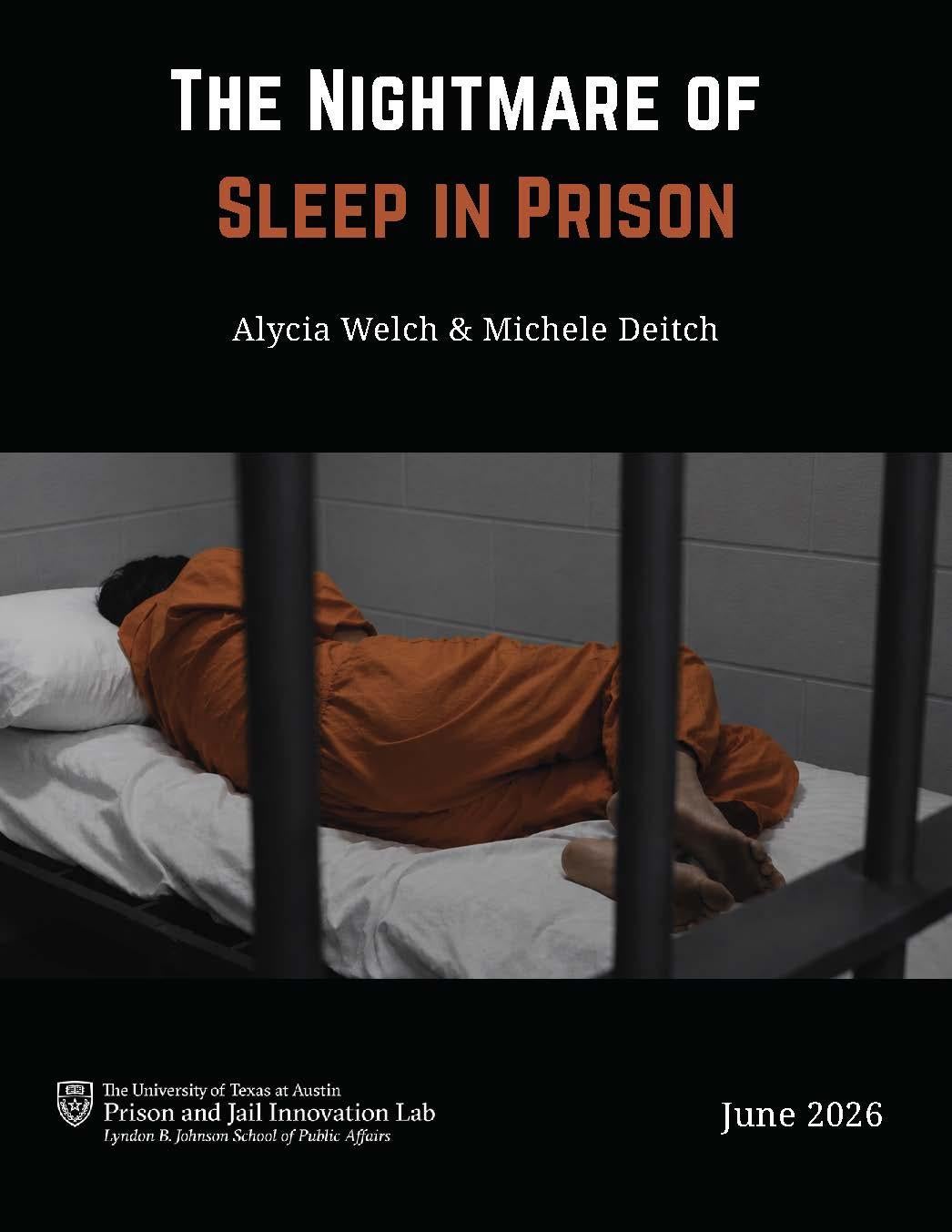
AUSTIN, TX — A new report from the Prison and Jail Innovation Lab (PJIL) at The University of Texas at Austin’s Lyndon B. Johnson School of Public Affairs reveals that chronic sleep disruption is a widespread and overlooked feature of incarceration in U.S. prisons and jails, with serious consequences for the physical and mental health of incarcerated people, institutional safety, and public health.
The report, The Nightmare of Sleep in Prison, examines how routine conditions and operational practices in carceral settings impact the ability of incarcerated people to experience restorative sleep—an active biological process that affects how people think, feel, and behave. Drawing on scientific research, first-person accounts from currently and formerly incarcerated people, corrections officials, and oversight reports from across the country, the report reveals the impact of chronic sleep loss on every aspect of life in prisons and jails.
“Sleep is a basic biological necessity, not a luxury,” said Alycia Welch, Associate Director of PJIL and lead author of the report. “Yet in prisons and jails across the country, people are routinely subjected to conditions that make restorative sleep nearly impossible. Chronic sleep loss affects the physical and mental health of incarcerated people, increases stress and tension inside facilities, and undermines the rehabilitative outcomes corrections agencies are supposed to support.”
The report documents how sleep in prisons and jails is disrupted by the cumulative effect of the physical conditions, operational practices, and institutional routines that shape daily life throughout a full day and night. Inadequate physical sleeping conditions—including thin mattresses, unsafe sleeping arrangements, unregulated temperatures, excessive lighting, and persistent noise—make it difficult for the body to transition to deeper, restorative stages of sleep. Institutional routines such as nighttime counts, medication distribution in the middle of the night, and unusually early wake times further fragment sleep and override the body’s natural rhythms. In many facilities across the nation, incarcerated people report receiving medication as early as 2:30 a.m. and breakfast around 4:00 a.m., leaving many without more than two or three hours of uninterrupted sleep at a time.
Moreover, daytime conditions compound the problem, as limited access to exercise, programming, meaningful activity, social interaction, and time outdoors weakens the body’s natural sleep regulation processes and disrupts healthy sleep-wake cycles. Fear and anxiety leave many incarcerated people unable to obtain restorative sleep, even when opportunities for sleep exist. The report also examines how these conditions affect some incarcerated people—including elderly people, women, and people living with physical and mental health challenges—in distinct ways.
Importantly, the report emphasizes that sleep loss in custody is not a matter of discomfort. Research consistently links chronic sleep disruption to increased risks of cardiovascular disease, weakened immune functioning, depression, anxiety, impaired emotional regulation, and cognitive impairment. Within correctional settings, chronic sleep disruptions can also increase interpersonal conflict, exacerbate behavioral health crises, impair decision-making, and heighten institutional tension.
“Corrections officials naturally focus on safety, security, and operational efficiency, and don’t realize the extent to which chronic sleep loss affects all of those things,” said Michele Deitch, Director of PJIL and co-author of the report. “People who are chronically exhausted are more likely to struggle emotionally, physically, and behaviorally. If corrections leaders want safer and more stable facilities, finding ways to improve sleep conditions must become part of the conversation.”
The report also highlights that the effects of chronic sleep disruption often continue long after incarceration ends. Formerly incarcerated people described ongoing physical and mental health consequences, persistent sleep difficulties, and challenges reestablishing healthy sleep patterns after returning home. These accounts underscore how sleep disruption during incarceration can shape long-term well-being even after someone is released from custody.
Many of the conditions that undermine restorative sleep are not inevitable features of incarceration, the authors emphasize, but operational and policy choices that can be changed. The report identifies institutions where operational changes that lead to improved sleep practices have been made without undermining safety and security. It offers a series of practical recommendations for corrections agencies and policymakers aimed at improving sleep conditions while supporting institutional safety and operational goals.
As Welch observed, “The recommendations do not ask agencies to choose restorative sleep over safety and security. Instead, they show that adjusting operations to support restorative sleep can address many of the conditions that undermine safety in the first place.”
Recommendations include:
- Install “normal” beds raised off the floor;
- Improve the quality of mattresses and bedding;
- Increase personal space for sleep;
- Increase the amount of dedicated, uninterrupted sleep;
- Redesign nighttime count protocols to avoid waking people overnight;
- Reduce loud, disruptive noises during designated sleep periods;
- Replace fluorescent lighting or use light covers;
- Provide eye masks and ear plugs to incarcerated people;
- Maintain nighttime temperatures within the optimal range for supporting sleep;
- Improve interactions between staff and incarcerated people;
- Keep people busy and active during the day;
- Normalize meal timing and improve food quality.
The report is the culmination of a multi-year project that was part of PJIL’s broader efforts to examine how routine conditions and operational practices shape the experience of incarceration and how these practices can be improved to reduce harm and promote the safe and humane treatment of incarcerated people.
The report was authored by Alycia Welch, Associate Director of the Prison and Jail Innovation Lab at the LBJ School of Public Affairs at The University of Texas at Austin, and Michele Deitch, Distinguished Senior Lecturer and Director of the Prison and Jail Innovation Lab. The Prison and Jail Innovation Lab is a national policy resource center working to ensure the safe and humane treatment of people in custody. For more information, contact: pjil@austin.utexas.edu.