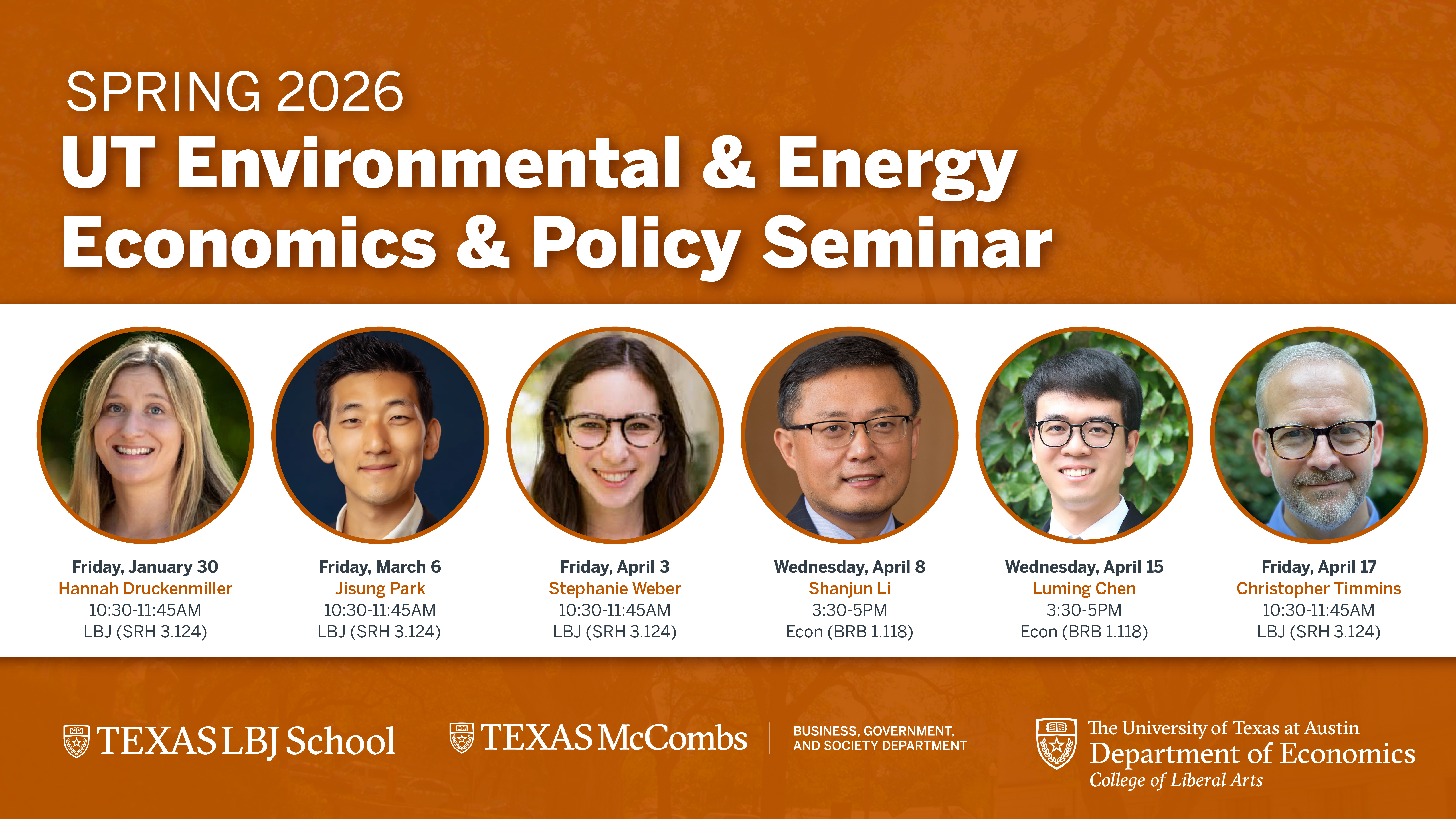
The LBJ School of Public Affairs, UT Economics, and the McCombs Department of Business, Government, and Society will continue our Environmental Economics research series for the Spring 2026 semester. Come hear from academics and subject matter experts in the field, including:
January 30: Hannah Druckenmiller, Department of Economics, California Institute of Technology (Caltech)
10:30-11:45 AM LBJ (SRH 3.124)
March 6: R. Jisung Park, Department of Social Policy and Practice, University of Pennsylvania
10:30-11:45 AM LBJ (SRH 3.124)
April 3: Stephanie Weber, Department of Economics, University of Colorado Boulder
10:30-11:45 AM LBJ (SRH 3.124)
April 8: Shanjun Li, Department of Global Sustainability, Stanford Doerr School of Sustainability
3:30-5:00 PM Econ (BRB 1.118)
April 15: Luming Chen, Department of Economics, University of Michigan
3:30-5:00 PM Econ (BRB 1.118)
April 17: Christopher Timmins, Department of Real Estate and Urban Land Economics Department at the Wisconsin School of Business
10:30-11:45 LBJ (SRH 3.124)
About the Speakers
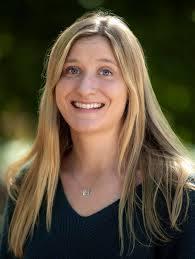
Hannah Druckenmiller is an Assistant Professor of Economics and William H. Hurt Scholar at the California Institute of Technology (Caltech). She is a Faculty Research Fellow at the National Bureau of Economic Research(NBER), University Fellow at Resources for the Future, and an affiliate of Caltech’s Linde Center for Science, Society, and Policy.
Her research aims to provide empirically based estimates for the environmental benefits and economic costs associated with natural resource protection. For example, she works in quantifying the flood mitigation value of natural lands, developing new approaches for accounting for ecosystem services in climate policy, and identifying cost-effective climate adaptation solutions.
She received her PhD in Agricultural and Resource Economics in 2021 from UC Berkeley, where she was a doctoral fellow at the Global Policy Lab and an NSF Graduate Research Fellow.
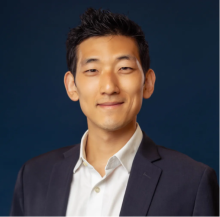
R. Jisung Park is an environmental and labor economist interested broadly in how environmental factors shape economic opportunity. He is particularly interested in the effects of the natural environment on labor markets and human capital outcomes, the process by which firms and households adapt to environmental change, and the implications of climate change for economic mobility.
R. Jisung, received his PhD in economics from Harvard University (2017), where he was an NSF Fellow, and master’s degrees in Environmental Change and Management (MSc) and Development Economics (MSc) from Oxford University (2010, 2011), where he was a Rhodes Scholar.
Currently, he is an assistant professor at the University of Pennsylvania, with appointments in the School of Social Policy and Practice (primary) and the Wharton School’s Department of Business Economics and Public Policy (secondary). He is also a research affiliate at the Institute of Labor Economics (IZA), and a faculty affiliate of the California Policy Lab (CPL), the Wharton ESG Initiative, and the Kleinman Center for Energy Policy.

Stephanie Weber is an assistant professor in the Economics Department at the University of Colorado Boulder and is a fellow at the Renewable & Sustainable Energy Institute (RASEI). Her research interests are energy & environmental economics and empirical industrial organization. Her current research studies fuel undervaluation and policy in heavy-duty vehicles, electric vehicle adoption, and interactions between electrification and other environmental policies.
She also help run YEEHAW!
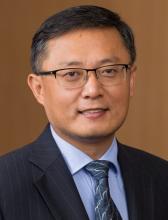
Shanjun Li is the Steven and Roberta Denning Professor of Global Sustainability in the Stanford Doerr School of Sustainability, and a Senior Fellow at both the Freeman Spogli Institute for International Studies and the Stanford Insitute for Economic Policy Research. He directs the Sustainability and Energy Transition Program at Stanford Center on China's Economy and Institutions (SCCEI). His research focuses on environmental and energy economics, urban and transportation economics, empirical industrial organization, and the Chinese economy. His recent work examines pressing sustainability challenges and the rapid rise of clean energy industries in China, exploring their global implications to support evidence-based policymaking.
Prior to joining Stanford, he held the Kenneth L. Robinson Chair in the Dyson School of Applied Economics and Management at Cornell University and served as the Director of the Cornell Institute for China Economic Research. He is a co-editor for the Journal of Public Economics and the International Journal of Industrial Organization. He is a research associate at the National Bureau of Economic Research (NBER) and a university fellow at Resources for the Future (RFF).
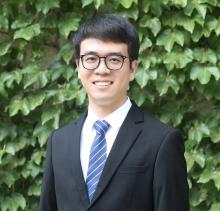
Luming Chen is an assistant professor of economics at the University of Michigan, working on industrial organization, environmental and energy economics, and productivity. He received his Ph.D. in Economics at University of Wisconsin-Madison in 2024. He was a postdoctoral researcher at Stanford University in 2024-2025.
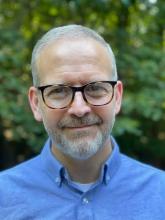
Christopher Timmins is the Gary J Gorman Affordable Housing Professor in the Real Estate and Urban Land Economics Department at the Wisconsin School of Business. Professor Timmins specializes in urban and environmental economics, but he also has interests in industrial organization, development, public, and regional economics. He works on developing new methods for non-market valuation of local public goods and amenities, with a particular focus on hedonic techniques and models of residential sorting. His recent research has focused on measuring the costs associated with exposure to poor air quality, the benefits associated with remediating brownfields and toxic waste under the Superfund program, the valuation of non-marginal changes in disamenities, and the causes and consequences of “environmental injustice”.