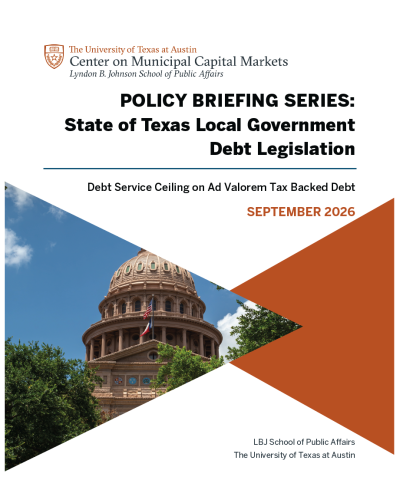
AUSTIN, Texas (September 29, 2026)— A new policy brief from the Center on Municipal Capital Markets (CMCM) at the LBJ School of Public Affairs at The University of Texas at Austin examines a debt limit Texas lawmakers considered in 2025, which would have capped annual debt service at 20% of property tax collections. The brief finds that all 15 of the state's largest cities already exceed that limit; had the law passed, it likely would have significantly curtailed new infrastructure borrowing by local governments.
The brief discusses the purposes of local debt limitations, details previous empirical research on their efficacy in other circumstances and examines local debt legislation that was introduced during the 89th Texas Legislature. It specifically examines House Bill 19, which aimed to set the maximum debt service ceiling of 20% of average property tax collections over the prior three years. The bill did not pass but drew extensive testimony, and similar proposals may return in the 90th Legislative Session. Among Texas's 15 largest cities, current debt service ratios range from 26% to 73%, with a median of 35%, which is well above the proposed ceiling.
Rather than apply the same debt limit to every local government regardless of circumstance, the report argues Texas needs a more tailored approach.
"Debt limitations aim to advance a noble goal, namely applying fiscal discipline on local governments. However, a statewide debt service ceiling treats every local government the same, whether it's a fast-growing suburb or a city that already has an established infrastructure,” said Martin Luby, lead author of the report, CMCM Faculty Director and Associate Professor at the LBJ School. “We believe Texas is better served by letting local governments set their own debt ceiling policies, paired with real state-level monitoring that can flag actual fiscal warning signs. That gives the state oversight without inhibiting infrastructure investment in places that are still growing."
The report is the first in a planned series examining local government debt legislation, with future briefs addressing additional provisions considered during the 89th Legislature. Read the full report here.
ABOUT THE CENTER ON MUNICIPAL CAPITAL MARKETS
The Center on Municipal Capital Markets (CMCM) at The University of Texas-Austin is one of the only university-based centers focused exclusively on municipal capital markets. CMCM’s mission is to enhance the capital market expertise and knowledge of undergraduate and graduate students, emerging and seasoned state and local government finance professionals and the public at large. CMCM achieves this through graduate and continuing education programs, experiential training, research and technical reports, and public outreach.
ABOUT THE LYNDON B. JOHNSON SCHOOL OF PUBLIC AFFAIRS
The LBJ School of Public Affairs at the University of Texas at Austin is one of the nation's premier public policy schools, uniquely positioned within a top-tier research university, the state capital and one of America's most innovative cities. Founded in 1970 by President Lyndon B. Johnson to expand access to the halls of power, the school offers a range of nationally ranked degree programs that prepare students to take on society's most pressing challenges. The LBJ School also provides career development and leadership training to emerging policy leaders and operates numerous research centers that develop solutions to complex local, state, national and global challenges.