
This month, graduate students in the LBJ School’s Policy Research Project on Ukraine’s water sector took part in a simulation that transported them to the year 2030.
In this scenario, a wastewater treatment plant in Zalishchyky, a small town in western Ukraine, had opened on schedule, but the river beside it was barely cleaner. When the European Commission requested treatment data, nobody could provide it. Playing the roles of the institutions responsible for the project, students had one afternoon to work together, uncover what went wrong and identify the challenges standing in the way of meaningful water sector reform.
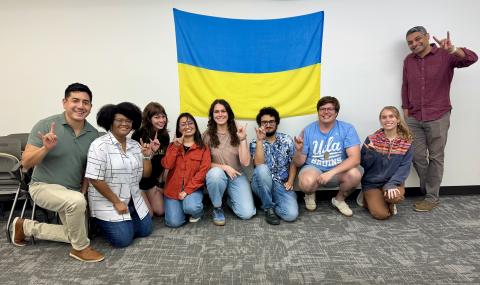
The simulation anchored the course "Delivering Water Sector Reform in Ukraine," a year-long Policy Research Project led by Professor Sachin Shah. Each student took a seat as one of the institutions involved in the project: the city council, the municipal water utility, the Ministry of Finance, the Ministry for Communities and Territories, the Ministry of Economy and Environment, the regional military administration, the Dniester River Basin Water Authority and an international development lender.
Why one wastewater plant matters
Ukraine is a candidate for European Union membership and joining means bringing its water management in line with EU law. At the center of that law is the EU Water Framework Directive, adopted in 2000. It asks countries to manage water by river basin instead of by political boundary. Ukraine’s first river basin management plans cover 2025 to 2030 and list hundreds of individual measures, from new treatment plants to river monitoring.
The Zalishchyky plant is a real project proposed for funding and implementation within the Dniester River Basin.
“A plan can pay for a plant and still fail to clean a river. Our students learn to read a single line in a reform plan and ask who must act, who pays and who is supposed to know whether it worked,” said Professor Sachin Shah.
How the inquiry worked
Six scenarios walked the room from 2026 to 2030: a national budget that took back local tax revenue, a rushed construction tender, a plant sized for homes that were never connected, a failed vote to raise sewer tariffs, winter blackouts from attacks on the power grid and a data request from the European Union. For each scenario, Professor Shah chaired the inquiry and posed pointed questions to specific institutions. Each student received a seat card containing information specific to their institution.
Whenever a student said some version of “I could not act until another institution did something,” the class marked that dependency and designated it as money, authority or information. By the end of the hour, the data showed which institutions served as hubs that other institutions depended on.

Systems thinking at the core
Systems thinking runs through the entire Policy Research Project. After the chain reaction, students turned the connections between institutions into things that can rise or fall, such as household sewer connections, utility revenue, plant operating hours and power costs. Together, they drew a causal loop: fewer connected homes mean less revenue, fewer operating hours for the plant, worse service and even fewer households willing to pay for a connection.
The two student teams, one assigned to the Middle Dnipro basin and one to the Dniester, will carry those links into fuzzy cognitive maps, a modeling method they use all year to test where reform can make the biggest difference. The lesson from Zalishchyky applies to both the Dniester and Dnipro river basins. The cheapest fix often sits one step upstream of the institution everyone waits on.
In their words
“The simulation helped me see the importance of establishing a top-to-bottom flow of processes and information. I think institutions get focused only on what they do, but don't understand where their part is in the overall process and how they impact it,” said Kiere Caston, a second-year MGPS student who represented Ukraine’s Ministry of Finance.
“It was nice to be in the shoes of the people and institutions involved. It showed me how complex these problems are and how important strong institutions are for solving them,” said Anisa Sifat, an MGPS student who represented the Dniester Basin Water Resources Management Department.
About the Policy Research Project
"Delivering Water Sector Reform in Ukraine" runs through the 2026-27 academic year. Students study Ukraine’s river basin management plans and their Programmes of Measures, then build evidence-based recommendations for clients in Ukraine. Project clients include Mariia Shpanchyk of Ukraine’s Ministry of Economy and Environment, Dr. Zakhar Rozlach of Taras Shevchenko National University of Kyiv and Dr. Oksana Sakal of the Land Management Institute of Ukraine. In the fall, students test potential measures against several possible scenarios for the war in Ukraine and the availability of financing. In the spring, they turn that diagnosis into measures their clients can deliver.
The course builds on Professor Shah's ongoing LBJ School work on Ukraine's recovery and European Union integration, including workshops and seminars on climate adaptation, food security and land and water governance with Ukrainian and international partners.